


 cxl@jihengfeng.com
 Español
 Français
 日本語
日本語
 العربية

- Blow Molding Die and Equipment Compatibility Adjustment: Technical Measures to Improve Production Stability
- Key Factors for Extending the Lifespan of Blow Molding Dies: 5 Essential Points to Avoid Common Operational Mistakes
- Stretch Blow Molding Dies vs. Extrusion Blow Molding Dies: Process Differences and Application Scenarios Comparison
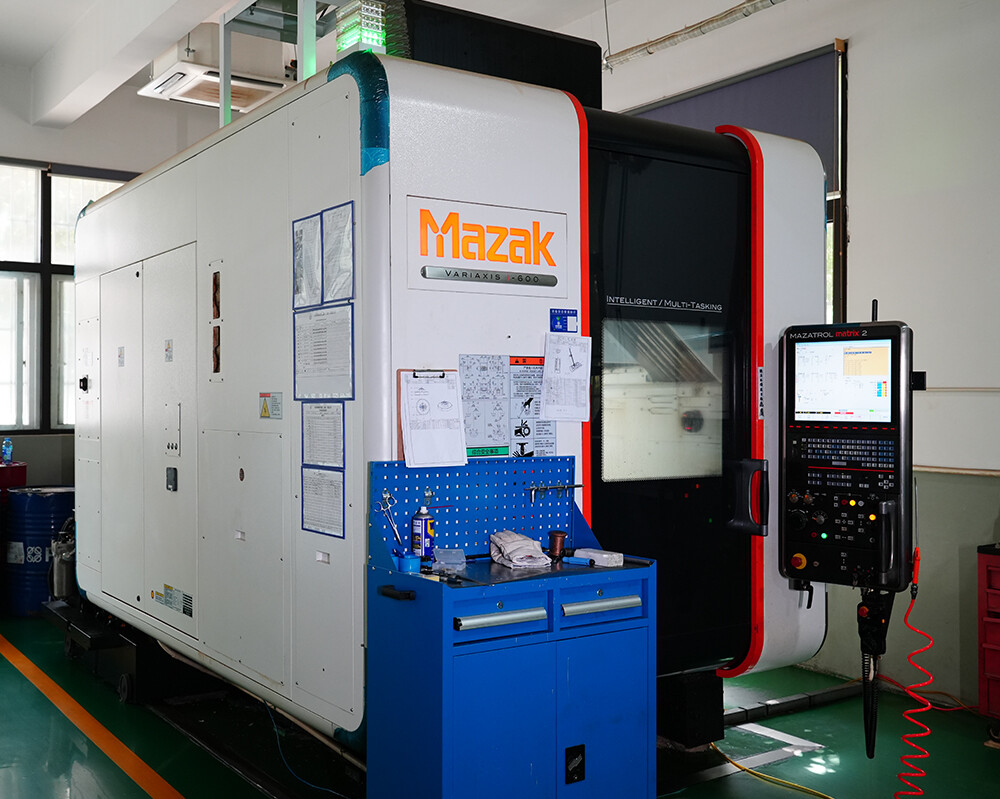
Blow Mold Machining—Mazak 5-Axis Machining Center Imported from Japan
- Category:Production equipment
- Hits:130次
- Release Date:2025-08-19
- Share:
- Details
In high-end mold manufacturing, the core advantage of 5-axis simultaneous machining is not simply adding degrees of freedom, but the precise control of the tool vector attitude. Taking this Japanese imported Mazak 5-axis machining center as an example, the rotation accuracy of its A and C axes directly determines the envelope angle range of the tool during spatial cutting. When facing deep cavities or undercut features, through tool path planning via CAM software, the tool can always maintain the optimal cutting geometric angle, avoiding dynamic interference between the tool holder and the workpiece—a physical barrier that 3-axis or 4-axis equipment cannot overcome.
This attitude control capability is particularly crucial when handling complex beverage packaging molds. Because the part surfaces often contain a large number of non-standard curved surfaces, if milled in multiple clamping setups, the seam marks would directly destroy the continuity of the surface. Relying on the Mazak's high-rigidity bed and 5-axis simultaneous interpolation algorithm, we can complete multi-surface machining under a single clamping. This process advantage is exactly the technical foundation that enables us to efficiently manufacture molds and spare parts for blow molding machines, filling machines, and labeling equipment that are compatible with brands such as Sidel, Krones, KHS, and Tetra Pak, ensuring the cavity surface meets the fluid dynamics requirements during high-speed blow molding or filling processes.
From the micro-level of mechanical operation, the Mazak's thermal displacement compensation system plays an important role in long-term continuous machining. The mold materials for packaging machinery are usually aluminum alloy or pre-hardened steel, and the massive amount of heat generated during cutting can cause minute thermal elongation of the spindle and rotary axes. By monitoring the temperature field in real-time and automatically micro-adjusting the coordinate zero point, this system eliminates the destruction of the dimensional chain caused by thermal deformation. Simultaneously, paired with the high-pressure internal coolant spindle, chips are broken instantly and evacuated with the cutting fluid, avoiding secondary cutting that could scratch the already machined mold surface.
Furthermore, during heavy cutting operations, the CNC system's real-time monitoring of spindle load can accurately capture the tool wear state. Once the cutting torque crosses the set threshold, the system automatically adjusts the feed rate. This adaptive control not only protects the spindle bearings but also ensures a high degree of consistency in the execution results of each machining program, thereby fully translating the precision potential of 5-axis machining into the physical quality of the mold.


